
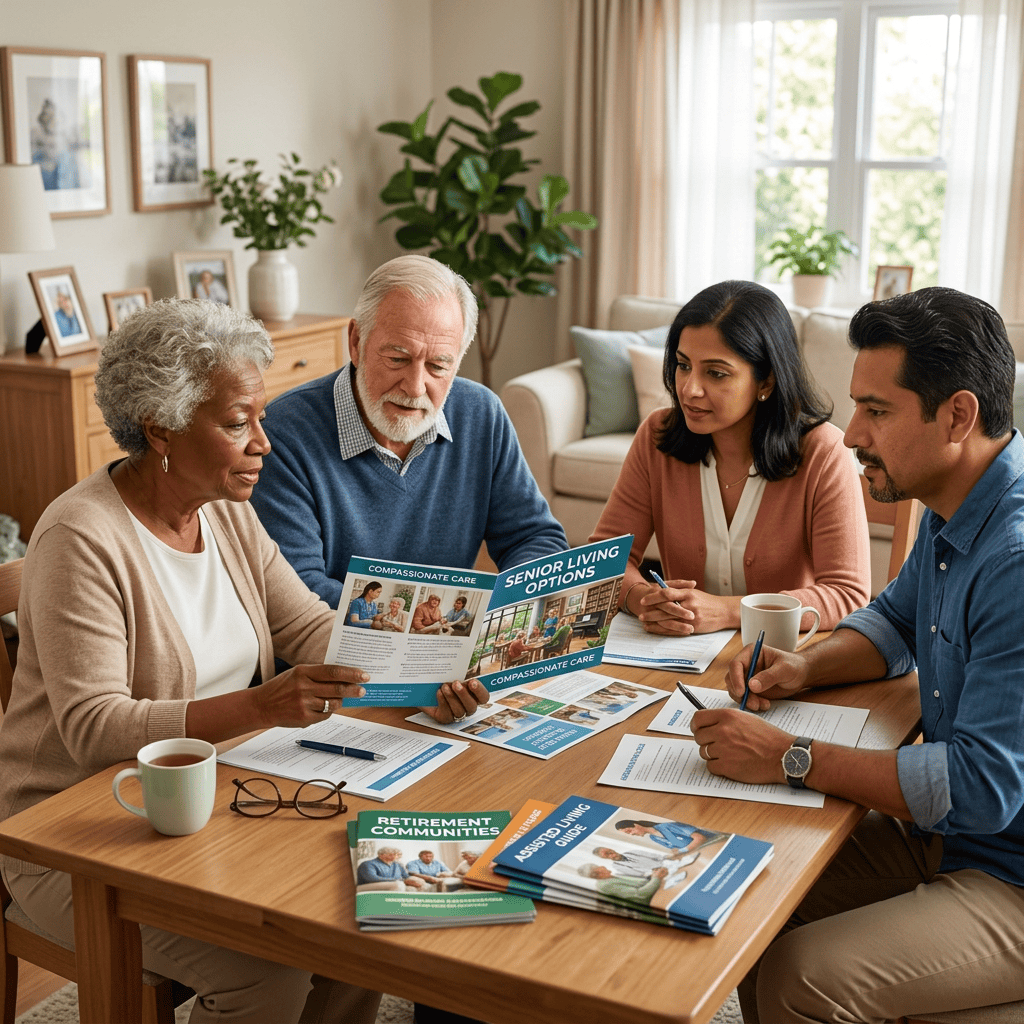
Last month, we talked about how to recognize when home might no longer be enough — the safety concerns, the exhaustion, the quiet moments of “is this still working?” If you’re reading this because you’ve already answered that question, take a breath. You didn’t fail. You paid attention. And now you’re standing in front of a whole new kind of overwhelming: a landscape of care options that all sound similar, cost different amounts, and somehow all claim to be “the right fit.”
This is where a lot of families get stuck — not because they don’t care enough to figure it out, but because no one ever handed them a map.
So let’s build one together.
Why This Part Feels So Hard
The terminology blurs together on purpose — or at least it can feel that way. In-home care, home health, adult day programs, assisted living, memory care, skilled nursing — the names sound close enough to interchangeable, but they’re built for very different needs. Nobody explains the differences to you until you’re already exhausted and trying to make a decision fast.
There’s no universal answer, and that’s disorienting. What worked for your neighbor’s mother might be completely wrong for your dad. Care needs are shaped by mobility, cognition, medical complexity, personality, finances, and geography — all at once. Families often want someone to just tell them the answer, and the honest truth is that the answer is specific to your situation, not a category.
Guilt tends to creep into the research itself. Some families feel like even looking at memory care is a betrayal, so they either avoid the research entirely or swing too far the other direction and assume more care is always safer. Neither extreme serves the person you love. The goal isn’t the most care or the least care — it’s the right care.
A Framework for Matching Care to the Situation
Think of care options less like a ladder you climb and more like a spectrum you move along — as needs change. It runs from staying at home, through lighter-support living arrangements, to more specialized and medically intensive settings.
55+ Communities sit right at the start of that spectrum, and they’re worth mentioning even though they’re not really a “care” option at all — they’re a lifestyle choice for someone who’s still fully independent, cognitively healthy, and simply ready for less upkeep and more company their own age. These communities come in a couple of different shapes: some are apartment-style buildings, others are traditional neighborhoods of single-family homes, townhomes, or patio homes, all restricted to residents 55 and older. Either way, the resident still owns or rents their own home and manages their own life — there’s no built-in care or staff oversight. What they’re really buying is proximity: neighbors at the same stage of life, walking trails, clubhouses, pools, and organized social activities right outside the door, along with lower home-maintenance demands than a typical house. Many of these homes are also already built with aging in place in mind — single-level layouts, wider doorways, grab bars, and elevated toilets are common features — which means a resident can often stay put longer, even as mobility changes, without needing to renovate or move again. For someone whose brain health is good but who’s noticing isolation creeping in after retirement, widowhood, or an empty nest, this kind of move can head off loneliness years before any care conversation is needed — while still preserving full independence and privacy.
Independent living is often the gentlest step down from a private home, and it tends to make sense earliest — usually while dementia, if present at all, is still in it’s very beginning stages. It’s not really a care level so much as a lower-maintenance lifestyle: meals, housekeeping, and built-in socialization are usually included, which can meaningfully lighten the load for someone who’s simply tired of the upkeep of a house or growing isolated living alone. Some independent living properties have options that are like apartment living with entrances to a large building and appear “hotel-like” in their lay-out. Others offer individual “bungalows” or small houses placed throughout the property and some offer both options. Independent living facilities/properties create more of a safety net, reduce isolation, help to keep older adults active, engaged and in community with others.
Independent living is not mutually exclusive with other support — some residents bring in home health aides or private caregivers on top of independent living when a bit of extra help is needed, without requiring a full move to a higher level of care. The arrangement varies by community: some independent living communities can be a straightforward lease, much like an apartment, while others are part of a continuing care retirement community (CCRC) — meaning the same campus offers assisted living, memory care, and skilled nursing as needs increase, so a person can move between levels of care without leaving the community they know. That distinction is worth asking about upfront, since it affects both cost structure and how much of a move a future transition would actually be. Some of these CCRC communities are also of a “buy-in” structure.
In-home care is a natural next layer, whether someone is still in a private home or already living in an independent living community — it lets a person stay in a familiar environment, which matters enormously for orientation and comfort, especially with dementia. This can range from a companion who provides socialization and light supervision a few hours a week, to a home health aide who assists with bathing, dressing, and medications, to more specialized dementia-trained in-home care for behavioral or safety needs. Some families choose in-home care with around the clock care in place instead of moving the loved one to a facility. However, In-home care works best when the environment itself is still safe and the main gap is supervision, task support, or caregiver relief.
Adult day programs fill a specific and often overlooked gap — they offer structured activity, socialization, cognitive stimulation and supervision during the day, while the person returns home each evening. This can be a lifeline for a caregiver who’s still working, or for a senior who’s isolated at home but not ready for a residential move. It’s also a gentle way to test how someone responds to more structured engagement before considering a bigger change. Generally adult day programs do not support attendees in self care needs, but they do offer close monitoring, cuing and encouragement to complete tasks that the person living with dementia is able to perform, mostly on their own.
Assisted living becomes the right fit when someone needs more consistent support with daily tasks — meals, medication management, mobility, bathing/dressing — but doesn’t require intensive medical or cognitive care. It offers built-in socialization and structure, which can actually improve quality of life for people who were becoming isolated at home. It’s not a step down in dignity; for many seniors, it’s a step up in engagement. While not all facilities are the same, most assisted living apartments are usually a 1-2 room set-up with private bathroom and meals are provided in a social setting.
Care homes are a newer concept. Rather than a large community with dozens or hundreds of residents, care homes — also called family care homes, or personal care homes — operate out of an actual residential house, typically with somewhere around six to eight residents sharing common spaces like the living room, kitchen, and dining room. The care provided can vary — help with daily tasks, meals, medication management, bathing/dressing — but with a higher staff-to-resident ratio and a much more home-like, less institutional feel. For a person who finds large communities overwhelming or overstimulating, that smaller scale can make a real difference. One important limitation to know upfront: many care homes are not equipped or licensed to accept someone who’s at risk of leaving the home unsupervised, since they typically lack the secured environment that setting requires. Licensing rules and quality also vary quite a bit from house to house, so this is an option worth touring in person and asking detailed questions about, rather than judging from a website alone.
Memory care is a distinct environment, not just “assisted living for dementia.” It’s specifically designed around the needs of people living with cognitive change — secured environments to prevent unsafe exploring, staff trained in dementia-specific approaches, and routines built around cognitive and behavioral needs rather than just physical ones. This tends to be the right fit when safety risks, exploring, significant behavioral changes, or advancing cognitive decline have outpaced what a general assisted living or in-home setting can safely manage.
Skilled nursing comes into the picture when medical needs become the primary driver — recovery from a hospitalization, complex medical management, or a level of physical care that goes beyond what assisted living or memory care staff are equipped to provide. Skilled nursing has nursing staff available 24 hours/day with a medical care team readily available to manage the medical complexities. It is possible for a person with cognitive deficits to also be appropriate for a skilled nursing facility, it’s depends on the circumstances. It’s worth knowing this option exists even if it’s not where your family is right now, because needs can shift.
The matching question isn’t “what’s the fanciest option” or “what’s the cheapest option” — it’s “what does this specific person need right now, and who can safely provide it.” It’s also about future planning and anticipating what needs may be coming. Safety, cognitive needs, medical complexity, social engagement, and caregiver capacity all factor in. And because needs change, the “right” answer today doesn’t have to be permanent.
The Takeaway
There’s no perfect option, and there’s no single roadmap that fits every family. What there is, is a clearer picture now of what each option actually offers — so you can match it to what’s really happening, instead of guessing in the dark or defaulting to whatever option feels least scary to talk about.
You don’t have to figure this out alone, and you don’t have to figure it out all at once. Wherever you land — still exploring, ready to visit a few places, or just trying to understand the vocabulary — that’s a reasonable place to be.
Wherever you are in this process, support is available at every stage — not just the research and the decision, but what comes after it, too. If a transition does end up being right for your family, how it’s handled matters almost as much as where it leads. Transitions are hard on anyone, and for a person living with dementia, an unsteady one can bring real confusion and distress. I help families think through how to make that shift as steady and reassuring as possible for the person at the center of it — the pacing, the communication, the small things that ease the disorientation of a big change.
What I don’t do is help you choose the specific place — that’s specialized work, and it deserves a specialist. When it’s time to look at actual options, tour communities, or compare costs and details facility by facility, I can connect you with placement professionals I trust who do exactly that.
If you’d like to talk through where you are at — whether that’s still sorting out the options or thinking ahead to how a transition might go — I offer a free 30-minute consultation. If you have questions about how to make your current setting more appropriate to support someone, I can help with that too. I look forward to hearing from you.

